

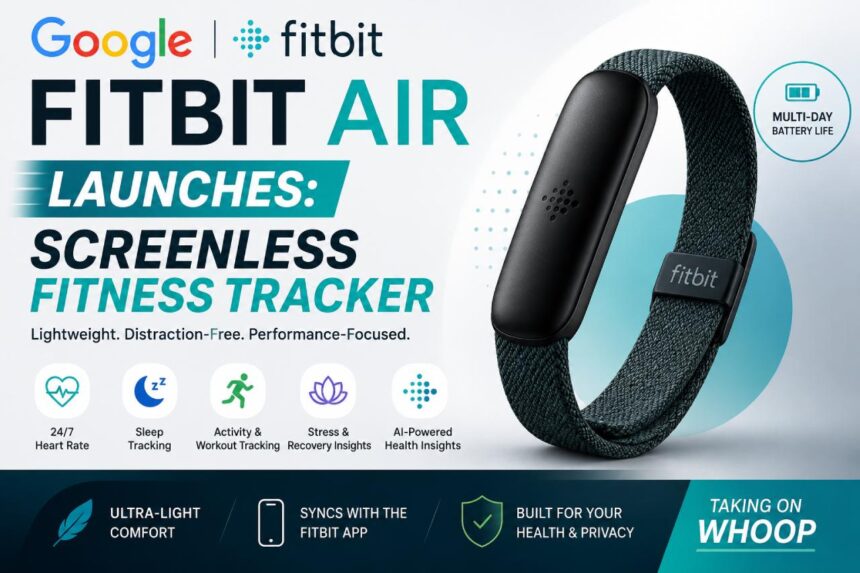
Google has officially introduced the Fitbit Air, a new screenless fitness tracker designed for users who want advanced health monitoring without the distractions of a traditional smartwatch. The launch marks Google’s latest effort to strengthen the Fitbit brand and compete directly with popular fitness wearables like Whoop.
- A New Approach to Fitness Tracking
- Key Features of Fitbit Air
- Competing With Whoop
- Focus on Recovery and Wellness
- Potential India Launch
- Future of Screenless Wearables
- FAQs: Google Fitbit Air Launch
- 1. What is the Google Fitbit Air?
- 2. How is Fitbit Air different from a smartwatch?
- 3. What health features does Fitbit Air offer?
- 4. Is Fitbit Air a competitor to Whoop?
- 5. Does Fitbit Air require a subscription?
- 6. Will Fitbit Air be available in India?
- 7. How long does the Fitbit Air battery last?
- 8. Who should buy Fitbit Air?
- 9. Can Fitbit Air track sleep and recovery?
- 10. When was Fitbit Air launched?
- FAQs: Google Fitbit Air Launch
A New Approach to Fitness Tracking
Unlike most fitness trackers and smartwatches, the Fitbit Air does not feature a display. Instead, it focuses entirely on health and fitness data collection, offering users a lightweight and distraction-free experience. The device continuously tracks key health metrics while syncing all information to the Fitbit mobile app.
Google says the tracker is designed for athletes, fitness enthusiasts, and health-conscious users who prioritize performance tracking over notifications and screen time.
Key Features of Fitbit Air
The new Fitbit Air comes with several health and fitness-focused features, including:
- 24/7 heart rate monitoring
- Sleep tracking and sleep score analysis
- Activity and workout tracking
- Stress and recovery insights
- AI-powered health recommendations
- Long battery life designed for multi-day use
- Lightweight and comfortable design
The device uses Fitbit’s health platform and Google’s AI capabilities to provide personalized wellness insights based on user activity and recovery patterns.
Competing With Whoop
The Fitbit Air enters a growing market of screenless fitness wearables dominated by Whoop. While Whoop has gained popularity among athletes for its recovery tracking and subscription-based model, Google is aiming to attract users with Fitbit’s established ecosystem and broader health-tracking capabilities.
Industry analysts believe the Fitbit Air could appeal to consumers looking for a simpler and potentially more affordable alternative to premium fitness tracking subscriptions.
Focus on Recovery and Wellness
One of the biggest trends in wearable technology is recovery monitoring. Fitbit Air emphasizes sleep quality, heart rate variability, stress management, and recovery readiness, helping users understand when to train harder and when to rest.
Google’s integration of AI-generated health insights could also help users make better fitness and lifestyle decisions based on their daily habits.
Potential India Launch
Reports suggest that Fitbit Air may eventually launch in additional global markets, including India. The wearable has already generated interest among fitness enthusiasts who are looking for advanced health tracking without investing in a full smartwatch.
While Google has not yet announced detailed availability plans for every region, industry watchers expect further rollout information in the coming months.
Future of Screenless Wearables
The launch of Fitbit Air highlights a growing shift toward minimalist wearable technology. As consumers seek better health tracking without constant digital distractions, screenless devices are becoming an increasingly attractive option.
With Fitbit Air, Google is betting that users want powerful health insights, longer battery life, and greater focus on wellness rather than another screen on their wrist.
Whether Fitbit Air can successfully challenge Whoop remains to be seen, but its arrival signals an exciting new chapter in the fitness wearable market.
FAQs: Google Fitbit Air Launch
1. What is the Google Fitbit Air?
Google Fitbit Air is a new screenless fitness tracker designed to monitor health and fitness metrics such as heart rate, sleep, activity levels, and recovery without the distractions of a smartwatch display.
2. How is Fitbit Air different from a smartwatch?
Unlike traditional smartwatches, Fitbit Air does not have a screen. It focuses entirely on health and fitness tracking, offering longer battery life and a more lightweight design.
3. What health features does Fitbit Air offer?
Fitbit Air includes heart rate monitoring, sleep tracking, activity tracking, stress insights, recovery metrics, and AI-powered health recommendations through the Fitbit app.
4. Is Fitbit Air a competitor to Whoop?
Yes. Fitbit Air is designed to compete with Whoop by offering advanced health and recovery tracking in a screenless wearable form factor.
5. Does Fitbit Air require a subscription?
Google has not confirmed all pricing and subscription details. However, some advanced health insights may be linked to Fitbit Premium, depending on the final product offering.
6. Will Fitbit Air be available in India?
While Google has not officially announced an India launch date, reports suggest the company may expand availability to additional markets, including India, in the future.
7. How long does the Fitbit Air battery last?
Google says Fitbit Air is designed for extended battery life, allowing users to wear it continuously for health and fitness tracking over multiple days.
8. Who should buy Fitbit Air?
Fitbit Air is ideal for athletes, fitness enthusiasts, and users who want detailed health tracking without smartphone notifications or a smartwatch screen constantly demanding attention.
9. Can Fitbit Air track sleep and recovery?
Yes. The device is built to monitor sleep quality, recovery readiness, heart rate trends, and overall wellness to help users make informed fitness decisions.
10. When was Fitbit Air launched?
Google officially introduced Fitbit Air in 2026 as part of its growing lineup of health-focused wearable devices aimed at the fitness and wellness market.