

In the realm of goods transportation in India, the E-Way Bill stands as a pivotal innovation, streamlining logistics and ensuring compliance under the Goods and Services Tax (GST) regime. Launched on April 1, 2018, the E-Way Bill system mandates the generation of an electronic bill for the movement of goods worth more than INR 50,000. This blog delves into the intricacies of the E-Way Bill, its significance, the generation process, and its impact on businesses.
What is an E-Way Bill?
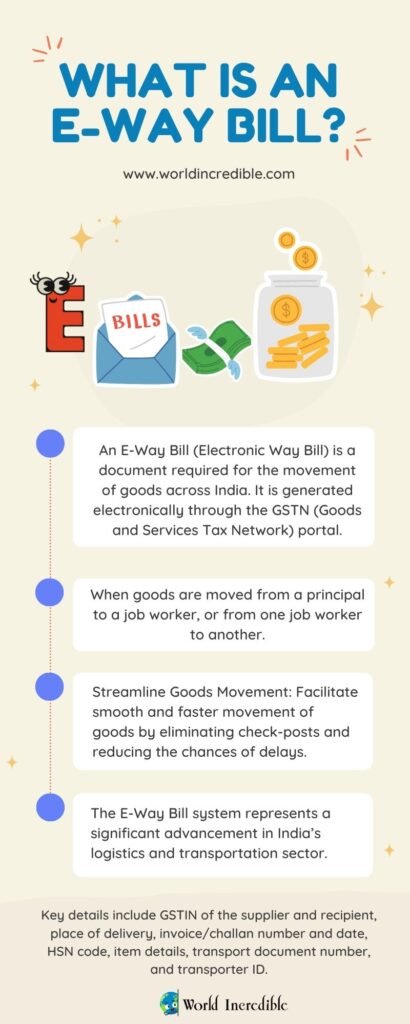
An E-Way Bill (Electronic Way Bill) is a document required for the movement of goods across India. It is generated electronically through the GSTN (Goods and Services Tax Network) portal. The bill serves as proof that the consignment is compliant with the GST rules, facilitating smoother inter-state and intra-state transport of goods.
What are the Key Components of an E-Way Bill?
An E-Way Bill contains critical information, such as:
Details of the consignor and consignee: Name, GSTIN (Goods and Services Tax Identification Number), and address.
Description of goods: Nature, quantity, and value of goods being transported.
Transport details: Mode of transport (road, rail, air, or ship), vehicle number, and transporter ID.
Place of origin and destination: Starting point and end point of the consignment.
When is an E-Way Bill Required?
An E-Way Bill is mandatory under the following conditions:
When the value of the consignment exceeds INR 50,000.
For inter-state movement of goods.
For intra-state movement of goods in certain states (as specified by state governments).
When goods are moved from a principal to a job worker, or from one job worker to another.
Exemptions from E-Way Bill Requirement
Certain situations exempt businesses from generating an E-Way Bill, such as:
Transportation of goods for personal use.
Consignments with a value less than INR 50,000.
Transport of goods exempted from GST.
Movement of goods within notified areas.
Objectives of the E-Way Bill
The primary objectives of implementing the E-Way Bill system are:
Streamline Goods Movement: Facilitate smooth and faster movement of goods by eliminating check-posts and reducing the chances of delays.
Reduce Tax Evasion: Ensure that goods being transported comply with GST laws, thereby reducing the possibility of tax evasion.
Enhance Transparency: Promote transparency and accountability in the supply chain by providing real-time tracking of goods.
E-Way Bill Impact on Businesses
Reduction in Transit Time: The abolition of state-border check-posts under the E-Way Bill system has significantly reduced the transit time for goods.
Cost Efficiency: Lower compliance costs and faster movement of goods translate into cost savings for businesses.
Improved Compliance: Automated and mandatory documentation reduces the risk of non-compliance and associated penalties.
How to Generate an E-Way Bill?
Generating an E-Way Bill involves a straightforward process on the GST portal:
Login: Access the GST E-Way Bill portal using your GST credentials.
Create New Bill: Select ‘Generate New’ under the ‘E-Way Bill’ tab.
Fill Details: Enter the necessary details, including the consignor, consignee, goods description, and transport information.
Submit and Generate: Submit the details to generate the E-Way Bill. A unique E-Way Bill number (EBN) will be assigned, which can be shared with the transporter.
Validity of an E-Way Bill
The validity of an E-Way Bill depends on the distance the goods need to travel:
For distances up to 100 km: 1 day.
For every additional 100 km or part thereof: 1 additional day.
The validity can be extended under certain circumstances, such as delays due to vehicle breakdown.
What Happens if Goods are Not Moved as per the E-Way Bill?
Q: What are the consequences if goods are not moved as per the e-way bill?
Transporting goods without a valid e-way bill can lead to:
A penalty equal to the tax amount or INR 10,000, whichever is higher.
Detention of goods and the vehicle.
Part A and Part B of the E-Way Bill
Q: What are Part A and Part B of an e-way bill?
Part A: Contains details of the consignor, consignee, and the goods.
Part B: Contains details of the vehicle or the transporter.
Q: What are the Benefits of the E-Way Bill System
Transparency and Accountability: Ensures real-time tracking of goods, reducing tax evasion.
Efficiency: Streamlines the movement of goods, minimizing delays at checkpoints.
Reduced Documentation: Eliminates the need for multiple paper documents, simplifying logistics.
Cost Savings: Cuts down transportation time and costs due to fewer regulatory hassles.
Challenges and Solutions
While the E-Way Bill system offers numerous benefits, it also presents challenges:
Technical Glitches: Frequent system downtimes can disrupt the generation of E-Way Bills.
Solution: Regular system upgrades and better IT infrastructure can mitigate this issue.
Complexity for SMEs: Small and medium enterprises may find it challenging to navigate the system.
Solution: Providing training and resources to SMEs can help them adapt to the system efficiently.
Conclusion
The E-Way Bill system represents a significant advancement in India’s logistics and transportation sector. Enhancing compliance, reducing bottlenecks, and ensuring seamless movement of goods, it supports the broader objectives of the GST regime. Businesses that effectively integrate the E-Way Bill process into their operations can expect improved efficiency and transparency, contributing to a more robust and accountable supply chain network.
As the system continues to evolve, staying updated with the latest regulations and leveraging technological tools will be crucial for businesses to maximize the benefits of the E-Way Bill system.
Frequently Asked Questions about E-way Bill
Q: What is an E-way Bill?
An E-way Bill is an electronic document required to move goods valued over INR 50,000 within India, as per the GST regime.
Q: When is an E-way Bill required?
Transporting goods in vehicles with a value exceeding INR 50,000 is required. It applies to interstate and intrastate movements.
Q: How to generate an E-way Bill?
You can generate an E-way Bill through the GST portal, SMS, or using the mobile app by providing details like consignor, consignee, goods, and transport.
Q: Who should generate the E-way Bill?
The responsibility lies with the registered person causing the movement of goods, either as a supplier a recipient, or the transporter.
Q: What details are required for generating an E-way Bill?
Key details include GSTIN of the supplier and recipient, place of delivery, invoice/challan number and date, HSN code, item details, transport document number, and transporter ID.