




The new era of artificial intelligence has delivered a plethora of digital assistants or virtual assistants who schedule meetings, answer questions, and provide reminders. Of course, ChatGPT Agents are a huge leap beyond that. Rather than simply responding to requests, they are changing the game with regard to AI in transitioning from passive assistants to active collaborative digital agents.
- The Rise of Independent Digital Agents
- 1. Autonomous and Accountable for Action
- 2. End-to-End Workflow Orchestration
- 3. Continuity of Learning and Memory
- 4. Adaptive Problem Solving
- 5. Integration Across Digital Ecosystems
- Real-World Implications
- The Future: Toward Digital Teammates
- Frequently Asked Question:
The Rise of Independent Digital Agents
In the past, AI assistants were scripted to perform limited designated tasks. ChatGPT Agents are now completely autonomous digital agents that can perform tasks that, until now, required greater human integration. They are designed to operate autonomously providing increased levels of autonomy and capacity.

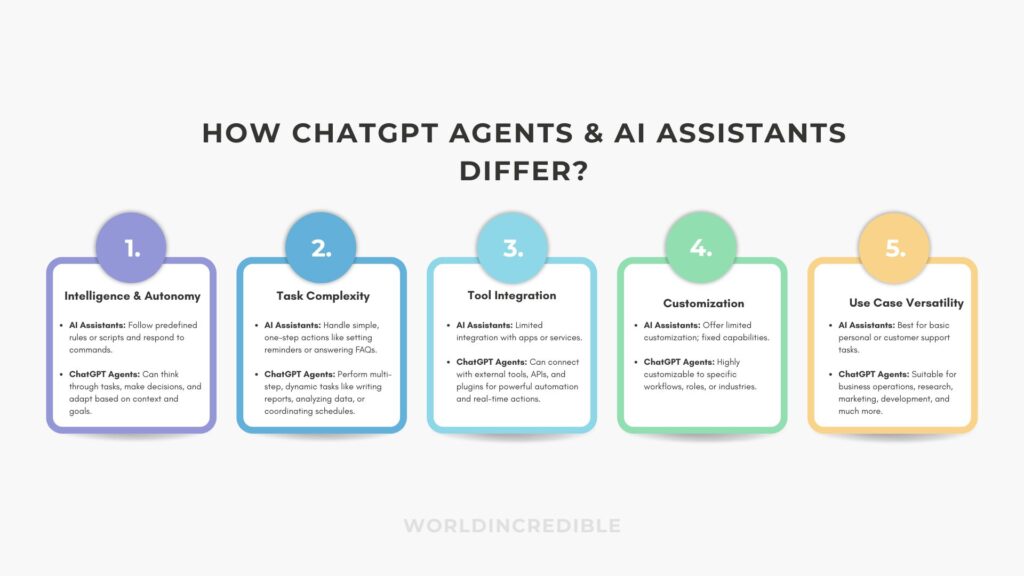
Here’s how they are different:
1. Autonomous and Accountable for Action
ChatGPT Agents can understand open-ended objectives as opposed to scripted tasks. They are given a generic task to complete—for example, “tabulate and summarize all client feedback for the month“—and they can take all necessary steps to accomplish this task on their own and adapt to the task requirements as new information is made available to them. Being autonomous means that, they are not simply completing tasks, they are actually moving the process forward.
2. End-to-End Workflow Orchestration
Instead of users providing every intermediate task, ChatGPT Agents can fluidly intermingle research, content creation, analytics, and communication. Given the task to generate a business report an agent can research the topics, discover and analyze critical data, and draft an action document; making use at every step of what it learns. This level of workflow orchestration is true in the sense we never saw in previous AI designs.
3. Continuity of Learning and Memory
A major leap is in their ability to maintain a form of, contextual memory from session to session. They learn our preferences and remember from previous interactions what data are relevant, and they rely on the historical context and learning to make their actions more appropriate. This enables truly long-term projects and customized recurring tasks that generate experiences that appear even more intuitive and “human”.
READ MORE: Why Everyone is Talking About OpenAI ChatGPT Agents?
4. Adaptive Problem Solving
Where many digital assistants struggle with non-routine tasks, ChatGPT Agents dynamically chart their own course through unfamiliar territory. Equipped to diagnose complex challenges, explore diverse digital tools, and experiment with different strategies, these agents display a level of creative problem-solving previously reserved for human collaborators.
5. Integration Across Digital Ecosystems
ChatGPT Agents are not confined to one app or service. Their virtual computing power allows them to interact with a wide variety of tools, APIs, and cloud environments. They can retrieve data, launch software, manage files, automate business processes, even interface with customer service platforms—all seamlessly woven into the digital landscape.
Real-World Implications
Businesses are piloting ChatGPT Agents for a host of advanced scenarios:
Automating research and reporting: Agents consolidate sources, generate insights, and distribute findings—much faster than manual teams.
Compliance monitoring: They continuously scan documentation and flag discrepancies according to changing regulations.
Knowledge management: Agents maintain evolving libraries of organizational knowledge, handling FAQs and updating content as business needs shift.
Strategic communication: Agents tailor messaging, summarize trends, and manage multi-channel communications.
For individuals, the technology brings an unparalleled level of delegation: users can offload repetitive digital chores, achieve more in less time, and focus on high-level strategic thinking or creativity.
The Future: Toward Digital Teammates
These developments push ChatGPT Agents beyond the realm of mere assistants. They are evolving into digital teammates, able to manage complexity, initiate action without constant supervision, and offer genuine partnership to their human counterparts. Their blend of autonomy, adaptability, contextual memory, and multi-tool integration foreshadows a future where collaboration with digital agents is as commonplace—and as transformative—as working with human colleagues.
In this new landscape, AI becomes not just a helper, but an empowered problem-solver and an orchestrator of digital possibility, opening the door to levels of productivity and creativity that were previously unimaginable.
READ MORE: Top 10 Incredible Things You Can Do with Google Gemini
Frequently Asked Question:
1. What are ChatGPT Agents?
They’re smart AI tools by OpenAI that can perform tasks, use tools, and follow complex instructions—much more advanced than basic chatbots.
2. How are they different from regular AI assistants?
ChatGPT Agents can plan, adapt, and take action across tasks, while traditional assistants are limited to simple commands.
3. What can I use them for?
They’re great for writing, research, coding, data analysis, customer support, and task automation.
4. Do I need coding skills?
No. You can give plain-language instructions, though advanced users can customize them with code.
5. Are they safe to use?
Yes, but avoid sharing sensitive data. Always double-check actions when agents are linked to external tools.