




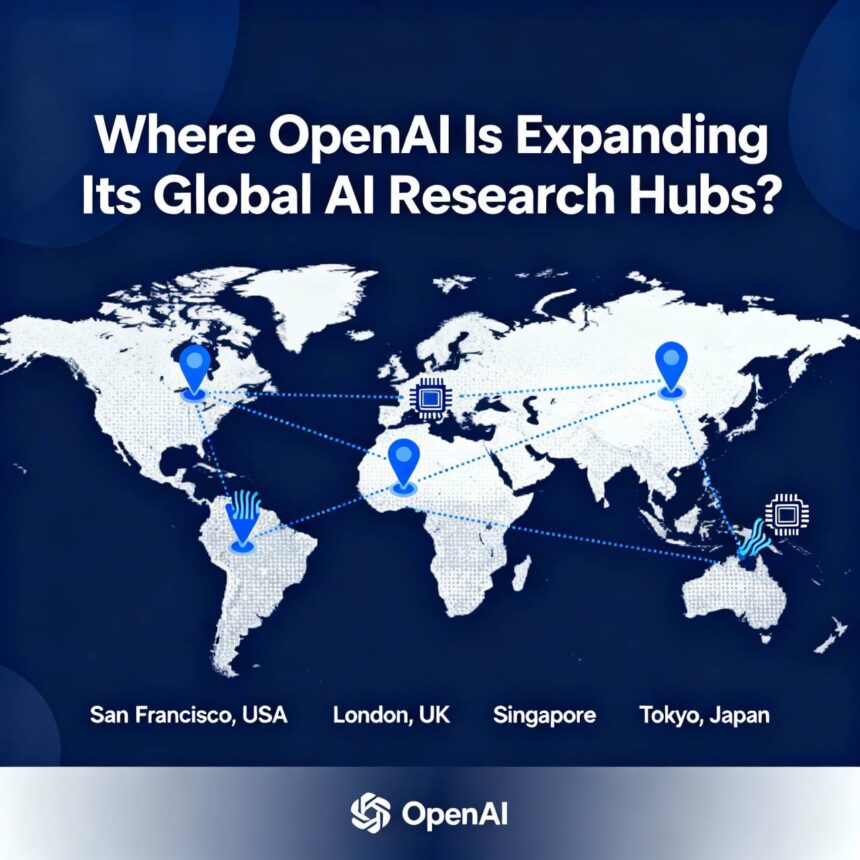
Artificial intelligence is no longer just a Silicon Valley narrative—the race for AI leadership is driving a global expansion. OpenAI, a leader in generative and large-scale AI research, is rapidly expanding its global footprint. Below is a snapshot of how, where, and why OpenAI is building new research hubs and data center infrastructure around the world.
Why Expand Now?
OpenAI is feeling several pressures to scale globally:
Demand for compute & infrastructure: To train large models, serve users at scale, and reduce latency, there will be more physical infrastructure—including data centers and regional offices.
Regulatory & policy engagement: Having a presence in different countries can help OpenAI manage national AI policy, regulation, compliance, and partner with governments and local research ecosystems.
Access to talent: Expanding into more regions allows OpenAI to tap into global pools of researchers, engineers, scientists, and innovators. Localized hubs also help speed recruitment and collaboration.
Sustainability & energy considerations: Some locations offer cooler climates, renewable energy, or favorable power-cost / infrastructure settings, which are increasingly important for powering large AI labs and data centers.
Read Also: Why ChatGPT Agents Are More Than Just AI Assistants?
Challenges and Considerations
Energy and environmental impact: Creating data centers of this magnitude requires massive amounts of power, cooling, and sometimes water. Local ecological issues, sustainability, and regulatory compliance are important.
Regulatory frameworks: Different nations have various AI regulations, along with laws regarding data sovereignty and privacy. Expanding worldwide will require compliance, local statutes and public confidence.
Infrastructure and workforce readiness: Some areas may have energy and network issues, staff may need training, and logistics (e.g., providing chips, cooling, etc.) will be more complicated.
Cost and timeline: The commitments are large; for example, the Stargate project alone is aiming to secure 10 gigawatts of compute, as well as a potential of up to US$500 billion. To achieve those numbers globally and quickly is a significant undertaking.
What does this mean for the Global AI Landscape?
Decentralization of AI power, where there will be compute hubs distributed around the globe, versus several data centers in Silicon Valley. This can aid latency, democratize access, and better provide AI services to serve local needs.
More office and innovation hubs, with local offices and research hubs, local developers and start-ups, and schools can have better access to OpenAI products, potentially creating innovation that is specific and useful for local contexts.
Where OpenAI Is Building / Planning New Hubs
Here are some of the key locations and initiatives (announced and in progress) for OpenAI’s global
| Region / Location | What’s Happening | Key Details |
|---|---|---|
| United States (Texas, New Mexico, Ohio, Midwest) | As part of Project Stargate (a joint project with Oracle & SoftBank) OpenAI is building multiple new AI data center campuses. (Reuters) | Sites include Milam County (TX), Shackelford County (TX), Doña Ana County (NM), Lordstown (OH), plus one undisclosed location in the Midwest. These centers aim to deliver nearly 7 gigawatts of compute capacity, part of a $500 billion investment program. (Reuters) |
| Abilene, Texas (USA) | Already built (or partially built) as one of the Stargate facilities – expected to be a major “supercluster” data center. (AP News) | Will include very large server capacity (e.g. tens of thousands of server racks), powered by a significant energy supply (solar, gas, etc.), with attention to sustainability. (Chron) |
| Europe – Norway (Narvik) | OpenAI has a project called Stargate Norway underway. (RCR Wireless News) | Will include very large server capacity (e.g., tens of thousands of server racks), powered by a significant energy supply (solar, gas, etc.), with attention to sustainability. (Chron) |
| Singapore, Paris, Brussels, Seattle, New York City | These serve more as research/engineering/regional coordination hubs rather than massive data centers. The Singapore hub, for example, is intended to support the Asia-Pacific. (TechCrunch) | These serve more as research/engineering/regional coordination hubs rather than massive data centers. The Singapore hub, for example, is intended to support Asia-Pacific. (TechCrunch) |
OpenAI’s worldwide extension demonstrates both its ambition and its necessity. If AI is to scale, be responsive, and be informed by a variety of voices and regulatory regimes, it is crucial to build research hubs and data center infrastructure around the world. There are significant challenges—technical, environmental, regulatory—but the direction is clear: AI’s future is global.
Disclaimer:
This article is for informational purposes only. The details provided about OpenAI’s global expansion, research hubs, and data centers are based on publicly available sources as of September 2025. Plans, locations, and timelines may change, and readers are encouraged to check official OpenAI announcements and trusted news outlets for the latest updates.