





Putting a leap in the digital infrastructure sector, India came up with DIGIPIN, a geo-coded digital address system. While a traditional PIN covers a massive area, the DIGIPIN makes it possible to assign a digital address to any location-an office, home, or even some remote shack.


Here is everything you need to know about it: how to check your DIGIPIN, its special features, and some other points that may not have been discussed more widely elsewhere.
What is DIGIPIN?
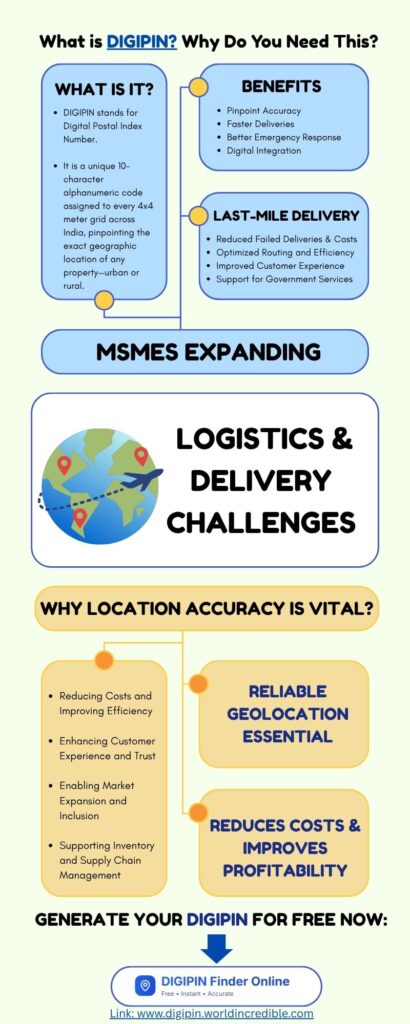
DIGIPIN (Digital Postal Index Number) is a unique, geo-coded, open-source address system developed by India Post in collaboration with IIT Hyderabad and ISRO’s National Remote Sensing Centre.
– It divides India into small 4×4 meter grids, assigning each a unique 10-character (sometimes reported as 12-character) alphanumeric code based on latitude and longitude.
– Unlike traditional PIN codes that cover large areas, DIGIPIN pinpoints precise locations—every home, office, or even a remote hut can have its own digital address.
READ MORE: How to check your DIGIPIN on your phone?
Why Is DIGIPIN So Much in Demand?
– Precision: Identification of exact location for logistics, emergency services, and e-governance.
– Inclusivity: Very useful in rural and hilly regions where traditional addresses are either vague or do not exist.
– Modernisation: Aids in implementation of the National Geospatial Policy 2022 of India, which envisages the development of strong geospatial infrastructure.
Key Features of DIGIPIN
– Open-source and Interoperable: Can be used by government, private sector, and individuals for various applications.
– Address-as-a-Service (AaaS): Forms the foundation for offering address-related digital services nationwide.
– Reverse Lookup: Users can retrieve coordinates from a DIGIPIN and vice versa, enhancing mapping and verification.
– Integration with GIS: Facilitates disaster response, logistics, and e-governance by integrating with Geographic Information Systems.
– Privacy: DIGIPIN does not store personal data; it only encodes geolocation.

How to Check or Generate Your DIGIPIN on Your Phone
1. Visit the Official Portal:
Go to the ‘Know Your DIGIPIN’ portal (e.g., dac.indiapost.gov.in/mydigipin/home or mydigipin.com).
2. Enable Location Access:
Allow your browser or phone to access your GPS location.
3. Consent to Privacy Policy:
Agree to the terms to proceed.
4. View Your DIGIPIN:
The portal will display the DIGIPIN for your current location.
– Alternatively, enter latitude and longitude coordinates to get a DIGIPIN for any point in India.
– You can also perform a reverse lookup: enter a DIGIPIN to see its mapped location.
How DIGIPIN Works?

What makes DIGIPIN different from traditional PIN codes?
Precision and Scope
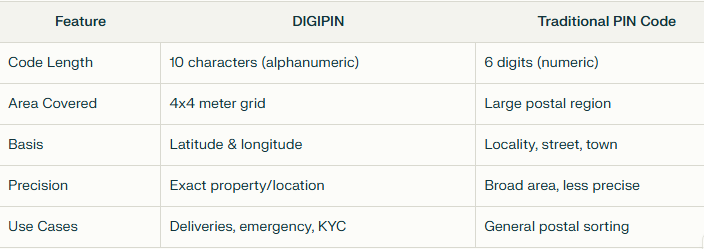
Traditional PIN codes in India are generally 6 digits and signify large geographical areas, often consisting of clusters of neighborhoods, towns, or even villages. This huge coverage of the PIN leads to confusion, incorrect deliveries, or locating an exact address when places have common names or address structures.
In contrast, the DIGIPIN is an exclusive 10-character alphanumeric code assigned for a 4×4 meter grid specified by the exact latitude and longitude coordinates of a location; this means that every property, home, or building has a separate code with pinpoint accuracy of the location.
Technology and Mapping
Derived from GPS coordinates and digital mapping, DIGIPIN divides India into small grid squares, with each square bearing a unique code. The grid-based system thus allows digitally precise addresses even in those rurally remote or newly developed areas lacking a formal address.
PIN codes are not drawn with reference to geographical coordinates and are not geared toward any digital incorporation or fine mapping.
Benefits Beyond the Basics
– Last-Mile Delivery: Ensures packages and government services reach even the most remote homes, overcoming the limitations of the traditional PIN code system.
– Emergency Response: Critical for timely medical, disaster, or police assistance, especially in areas with no clear addresses.
– Digital Inclusion: Bridges the digital divide by giving every citizen—regardless of location—a unique, verifiable address.
– Developer Friendly: Open-source nature allows startups and businesses to build new services atop the DIGIPIN platform.
– Geo-fencing of PIN Codes: India Post has also geo-fenced over 1.5 lakh PIN code areas, further improving address accuracy.
Points Not Covered in Most Articles
– Reverse Lookup and Developer Tools:
DIGIPIN’s technical documentation and source code are publicly available, encouraging integration with third-party apps and services.
– GIS and E-Governance Integration:
The system is designed to support advanced GIS applications, aiding not just logistics but also urban planning, disaster management, and digital governance.
-Address Modernisation Initiatives:
Launched alongside the ‘Know Your PIN Code’ portal, which helps users identify their traditional PIN code based on geolocation, further streamlining India’s address infrastructure.
– Beta Phase and Public Feedback:
The DIGIPIN system is in its beta phase, and India Post is actively seeking public feedback to refine the system before nationwide rollout.
Generate Your DIGIPIN NOW FOR FREE and Without Registration at https://digipin.worldincredible.com/
Conclusion
DIGIPIN is set to transform how India thinks about addresses—making them precise, digital, and universally accessible. Whether you’re a citizen, business, or developer, understanding and adopting DIGIPIN will be key to navigating India’s digital future.