




Body Mass Index (BMI) continues to serve as one of the most widely used tools for assessing weight status and health risks in men across the globe. Recent scientific research has revealed important nuances about how BMI affects men specifically, including its relationship with hormones, disease risk, and ethnic variations. This comprehensive guide explores everything you need to know about BMI tables for men, backed by the latest medical research and evidence-based insights.
- BMI Table for Men
- What is BMI and Why Does It Matter for Men?
- Standard BMI Categories for Men
- Latest Research on BMI and Men’s Health
- Ethnic Variations in BMI Interpretation
- BMI Limitations and Better Alternatives
- Health Implications by BMI Range
- BMI and Physical Activity
- How to Calculate Your BMI
- Recommended Monitoring
- Effective BMI Management Strategies
- Future Research and Trends
- Practical Recommendations for Men

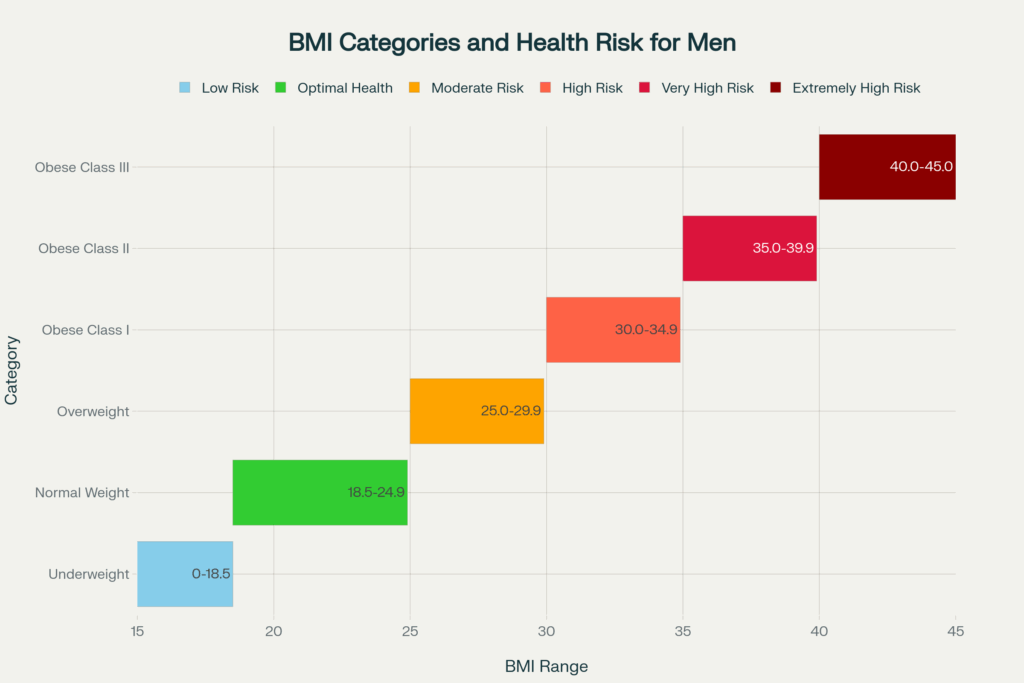
Image : BMI chart showing weight, height, and body mass index categories with health tips for maintaining a healthy weight.
Body Mass Index (BMI)
BMI Table for Men
| Weight Category(BMI) | Normal* (≥ 18.5 and < 25) | Overweight (≥ 25 and < 30) | Obese: Class I (≥ 30 and < 35) | Obese: Class II (≥ 35 and < 40) | Obese: Class III (≥ 40) |
|---|---|---|---|---|---|
| Height | Body Weight | ||||
| 60–61 in (152–155 cm) | 97–127 lb (44–58 kg) | 128–153 lb (58–69 kg) | 153–180 lb (69–82 kg) | 179–206 lb (81–93 kg) | > 206 lb (> 93 kg) |
| 62–63 in (157–160 cm) | 104–135 lb (47–61 kg) | 136–163 lb (62–74 kg) | 164–191 lb (74–87 kg) | 191–220 lb (87–100 kg) | > 220 lb (> 100 kg) |
| 64–65 in (162–165 cm) | 110–144 lb (50–65 kg) | 145–174 lb (66–79 kg) | 174–204 lb (79–93 kg) | 204–234 lb (93–106 kg) | > 234 lb (> 106 kg) |
| 66–67 in (168–170 cm) | 118–153 lb (54–69 kg) | 155–185 lb (70–84 kg) | 186–217 lb (84–98 kg) | 216–249 lb (98–113 kg) | > 249 lb (> 113 kg) |
| 68–69 in (173–175 cm) | 125–162 lb (57–74 kg) | 164–196 lb (74–89 kg) | 197–230 lb (89–104 kg) | 230–263 lb (104–119 kg) | > 263 lb (> 119 kg) |
| 70–71 in (178–180 cm) | 132–172 lb (60–78 kg) | 174–208 lb (79–94 kg) | 209–243 lb (95–110 kg) | 243–279 lb (110–127 kg) | > 279 lb (> 127 kg) |
| 72–73 in (183–185 cm) | 140–182 lb (64–83 kg) | 184–219 lb (84–99 kg) | 221–257 lb (100–117 kg) | 258–295 lb (117–134 kg) | > 295 lb (> 134 kg) |
| 74–75 in (188–190 cm) | 148–192 lb (67–87 kg) | 194–232 lb (88–105 kg) | 233–272 lb (106–123 kg) | 272–311 lb (123–141 kg) | > 311 lb (> 141 kg) |
| 76 in (193 cm) | 156–197 lb (71–89 kg) | 205–238 lb (93–108 kg) | 246–279 lb (112–127 kg) | 287–320 lb (130–145 kg) | > 320 lb (> 145 kg) |
| *BMIs less than those listed as normal are considered underweight. | |||||
Table reference from msdmanuals.com
What is BMI and Why Does It Matter for Men?
Body Mass Index (BMI) is a calculated measurement that uses your height and weight to estimate body fat and categorize weight status.
Formula:
- Metric: BMI = weight (kg) ÷ height (m)²
- Imperial: BMI = 703 × weight (lbs) ÷ height (inches)²
For men, BMI carries particular significance due to unique physiological factors. Studies show that obesity affects about 75% of men aged 40 or older in the U.S., making BMI a critical screening tool.

Standard BMI Categories for Men
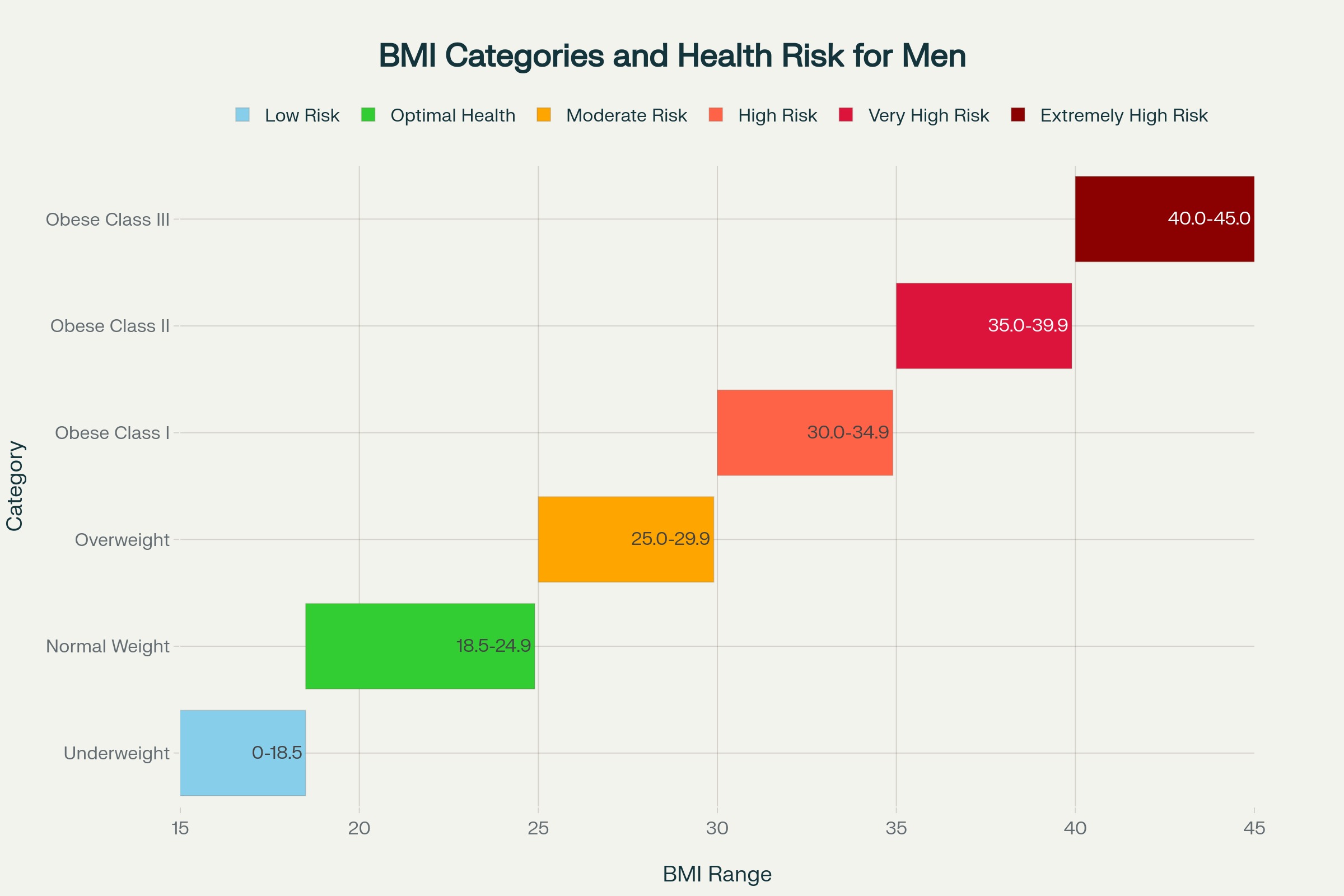
- Underweight: BMI < 18.5
- Normal Weight: 18.5–24.9
- Overweight: 25.0–29.9
- Obese Class I: 30.0–34.9
- Obese Class II: 35.0–39.9
- Obese Class III: ≥ 40.0
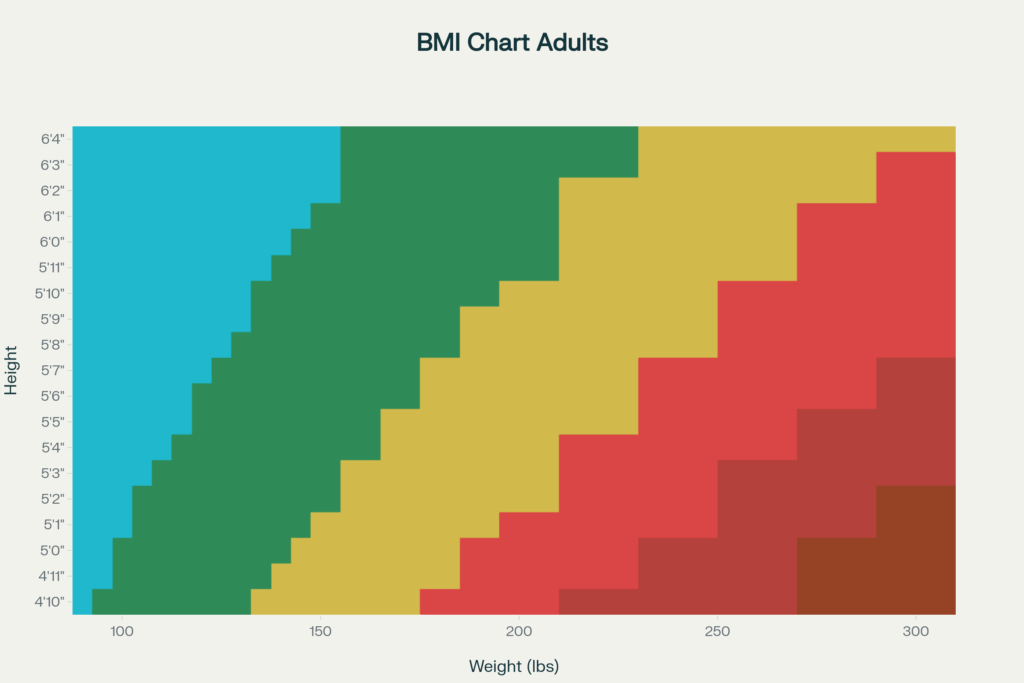
Comprehensive BMI Table by Height and Weight
Add a responsive table here to allow users to identify their BMI without calculating manually.
Latest Research on BMI and Men’s Health
Cardiovascular Disease Risk
Studies like the HIMS and British Regional Heart Study show increased risks of heart disease and diabetes with rising BMI, especially after middle age.
BMI and Male Hormones
- Obese men have up to 30% lower testosterone levels
- BMI >35–40 reduces testosterone by over 50%
- Weight loss improves testosterone levels by 13% or more

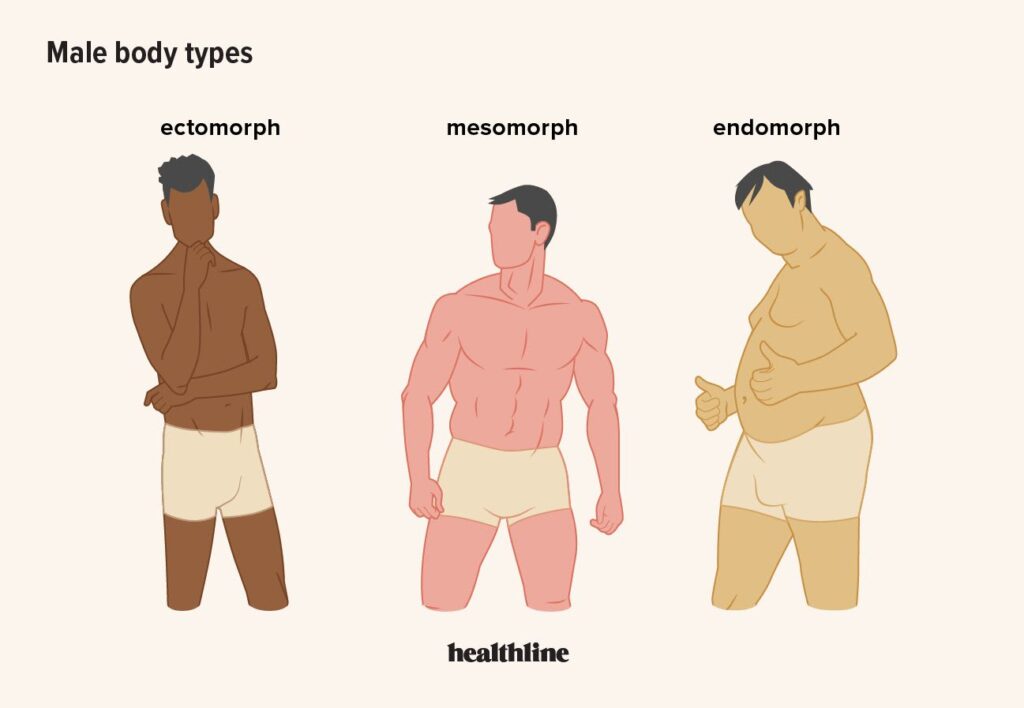
Image Source Healthline
Prostate Health
Higher BMI is linked to an increased risk of prostate cancer and benign prostate enlargement (BPH).
Ethnic Variations in BMI Interpretation
Asian Men
- Overweight: ≥ 23.0
- Obese: ≥ 25.0
African American and Hispanic Men
African American men tend to have higher muscle mass, while Hispanic men show faster BMI increases in early adulthood.
BMI Limitations and Better Alternatives
Key Limitations
- Doesn’t differentiate muscle vs fat
- Doesn’t show fat distribution
- Less accurate for older men
Better Alternatives
- Waist Circumference: > 40 inches = high risk (Asian men: > 35.4 inches)
- Waist-to-Hip Ratio: > 1.0 = high risk


Health Implications by BMI Range
Underweight (<18.5)
- Immune suppression
- Osteoporosis
- Respiratory risks
Normal Weight (18.5–24.9)
- Lowest mortality and disease risk
- Optimal hormone balance
Overweight (25.0–29.9)
- 20% higher mortality risk
- Increased diabetes risk
Obese (≥30.0)
- Class I: 45% higher mortality, lower testosterone
- Class II: 62% higher mortality, prostate concerns
- Class III: Extremely high risk, major hormonal disruption
BMI and Physical Activity
- Athletes: BMI 22.6, body fat 15.7%
- Active Men: BMI 23.4, body fat 18.9%
- Sedentary: BMI 24.3, body fat 20.6%
How to Calculate Your BMI
Formulas
- Metric: BMI = weight (kg) ÷ height (m²)
- Imperial: BMI = 703 × weight (lbs) ÷ height (in²)
Example
Metric: 75kg & 1.8m = BMI 23.15
Imperial: 165lbs & 70in = BMI 23.7
Recommended Monitoring
- Middle-age or older
- After lifestyle transitions
- When noticing health changes
Effective BMI Management Strategies
Lifestyle Interventions
- Nutrition: 500–750 calorie deficit
- Exercise: Cardio + resistance
- Sleep and stress management
When to Consider Medical Support
- Weight loss surgery for BMI >35
- Hormonal therapy evaluation
Future Research and Trends
- Personalized BMI standards
- Genetic analysis and causal studies
- Alternative metrics like BRI & BAI
- Hormonal interventions for obesity
Practical Recommendations for Men
Normal Weight
- Maintain current habits
- Monitor waist size & muscle mass
Overweight
- Lose 5–10% body weight
- Exercise ≥150 mins/week
Obese
- Medical & hormonal evaluation
- Structured program or surgery