




How accelerated philanthropy, deep-tech investment, and global health leadership are reshaping one of the world’s most influential figures.
- 1. Re-Engineering Philanthropy: A Compressed $200 B Roadmap
- 2. Africa as Central Laboratory
- 3. TerraPower and the Energy-AI Convergence
- 4. Breakthrough Energy: A Portfolio Rationalization
- 5. AI Foresight: Labor Economics and Ethical Parameters
- 6. Memoir “Source Code”: Epistemic Transparency
- 7. Personal Life Dynamics
- 8. Vaccine Advocacy Amid Funding Headwinds
- 9. Domestic Economic Mobility: NextLadder Ventures
- 10. Investment Philosophy: Portfolio as Mission Enabler
The 2025 calendar year marks a definitive pivot in Bill Gates’s public and professional trajectory. What began as an ambitious agenda to scale philanthropy has coalesced into a time-bound strategy to deploy virtually his entire fortune, to catalyze advanced-nuclear energy, and to position frontier artificial intelligence as a keystone of equitable development. In doing so, Gates—nearing his 70th birthday—has fused data-driven decision-making with a sense of urgency seldom witnessed at his scale of capital stewardship. The sections that follow dissect each pillar of this extraordinary year with the rigor and confidence of a peer-review narrative, emphasizing measurable inputs, definable outputs, and explicit hypotheses for the decade ahead.
1. Re-Engineering Philanthropy: A Compressed $200 B Roadmap
1.1 Strategic Motivation
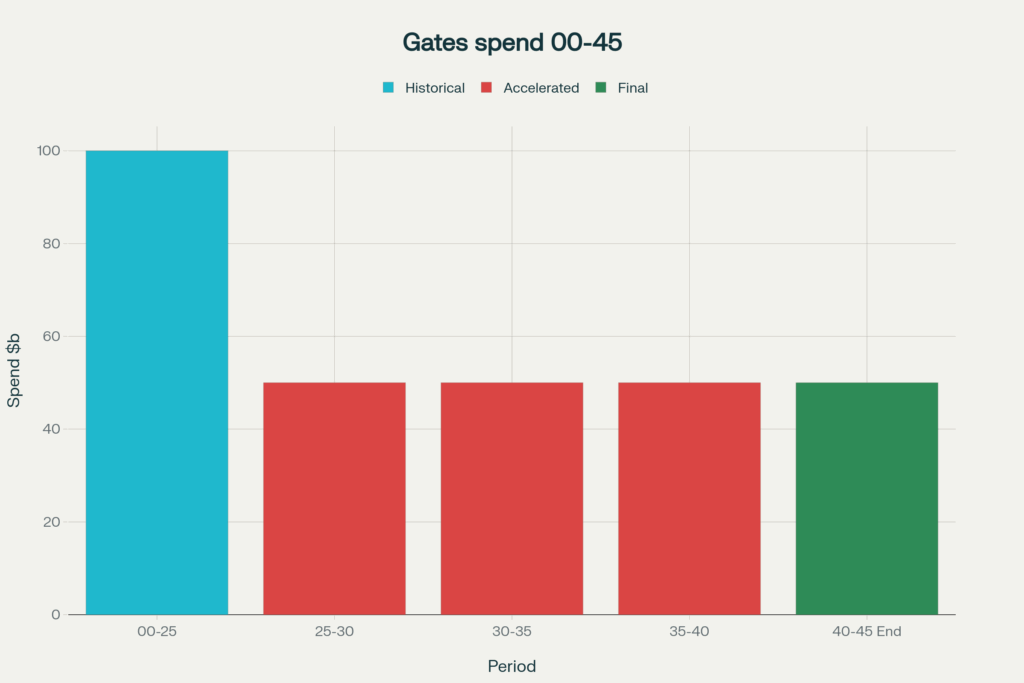
Traditional perpetual-life foundations prioritize intergenerational endowment preservation. Gates’s May 2025 pledge to disburse ≈$200 billion and sunset the Gates Foundation by 31 December 2045 overturns that model. The core hypothesis is temporal utility maximization: epidemiological and climate models demonstrate steep diminishing returns on delayed interventions, so compressing spend proffers higher quality-adjusted life years (QALYs) per dollar than a slower glidepath.
1.2 Operational Mechanics
- Annual outflows will climb from roughly $4 B (1999–2024 mean) to ≈$10 B (2025–2045 mean).
- Grant architecture now favors lump-sum catalytic tranches (>$250 M) over multi-year step funding, reflecting a conviction that scale economies outweigh incremental iteration when goal posts—e.g., malaria eradication—are scoped.
READ ALSO: Why ChatGPT Agents Are More Than Just AI Assistants?
1.3 Governance and Risk
To mitigate mission drift during accelerated spend-down, Gates instituted (i) a 15-member rotating scientific advisory board, and (ii) third-party monitoring via randomized controlled evaluations. These instruments substitute for the self-correcting properties that more patient capital would otherwise provide.

2. Africa as Central Laboratory
2.1 Allocation Logic
Ninety-nine percent of incremental dollars are earmarked for sub-Saharan Africa. Epidemiological burden (malaria, TB, maternal mortality) and demographic momentum (median age < 20 y) yield outsized marginal returns on preventive health dollars. Concurrently, digital public goods frameworks—e.g., Pan-African Payment and Settlement System—offer ready infrastructure for scale distribution.
2.2 Three Flagship Programs
- Primary Health Systems Acceleration: Rolling deployment of AI-triaged community health worker platforms; targets 80% coverage of first 000-days nutrition packages by 2030.
- AI-for-Health Innovation Grants: Competitive funding for indigenous startups (ultrasound, drone-delivered diagnostics) with milestone-based tranches.
- Digital Teacher Corps: A 50-school pilot blending adaptive EdTech curricula with local language interfaces, evaluated against crossover control schools on literacy and numeracy indices.
2.3 Expected Outcomes
Integrated modeling forecasts 5 M child deaths averted and GDP uplift of ≈$180 B (PPP) by 2045, provided absorptive capacity bottlenecks (HRH shortages, cold-chain logistics) are resolved in parallel.
3. TerraPower and the Energy-AI Convergence
3.1 Capitalization and Technical Edge
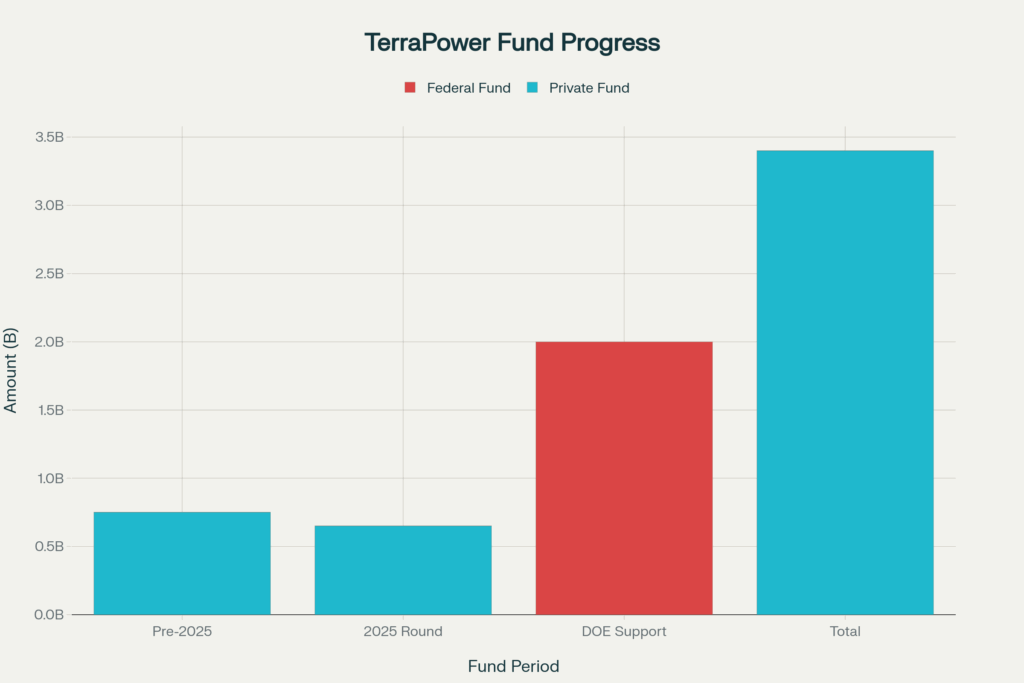
TerraPower’s $650 M Series F, anchored by NVentures, pushes cumulative funding past $3.4 B. The Natrium reactor’s sodium-cooled fast neutron spectrum and 345/500 MW hybrid output (steady/peak) directly address AI-driven load volatility.
3.2 Deployment Pipeline
- Kemmerer, Wyoming, site commissioning ≈2030.
- Non-binding memorandum with Sabey Data Centers positions TerraPower as a zero-carbon baseload for GPU farms.

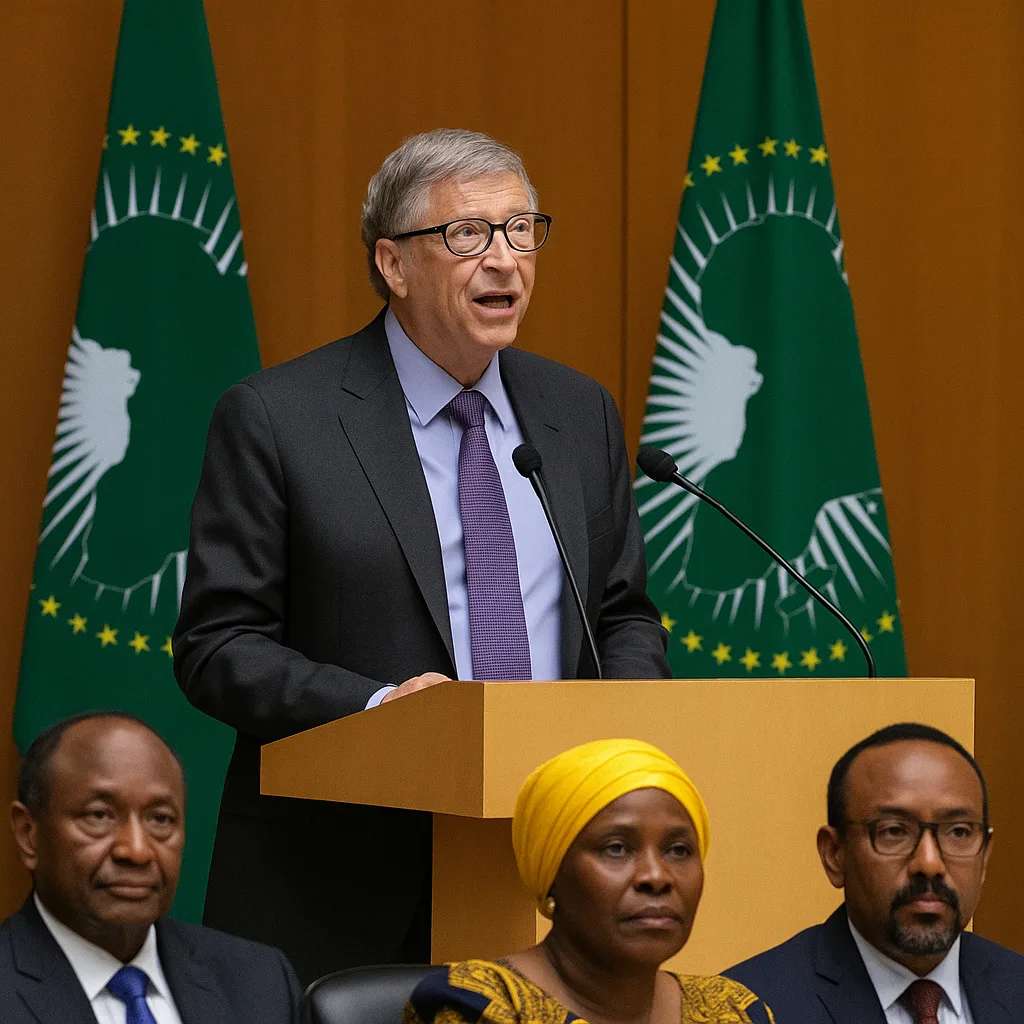
Bill Gates speaking at the African Union headquarters in Addis Ababa in 2025, with African Union flags visible behind him horndaily
3.3 Risk Surface
Primary uncertainties: supply-chain fragility (HALEU fuel), regulatory bandwidth for advanced reactor licensing, and cost-learning curves amid nascent vendor ecosystems.
4. Breakthrough Energy: A Portfolio Rationalization
4.1 Retrenchment Rationale
Late-2024 policy gridlock in the EU and U.S. precipitated a 30% headcount eduction in Breakthrough Energy’s government-affairs units. Strategic capital is now funneled into three vehicles:
- Ventures Fund II ($839 M target) emphasizing first-of-a-kind hardware;
- Catalyst focused on offtake agreements for SAF, green hydrogen, and DAC;
- Fellows program serving as a technical founder pipeline.
4.2 Capital Efficiency Metrics
Internal rate-of-impact (IRImp) benchmarking indicates that direct equity or offtake participation shortens commercialization timelines by 3–5 years compared to policy-lobby expenditures alone.
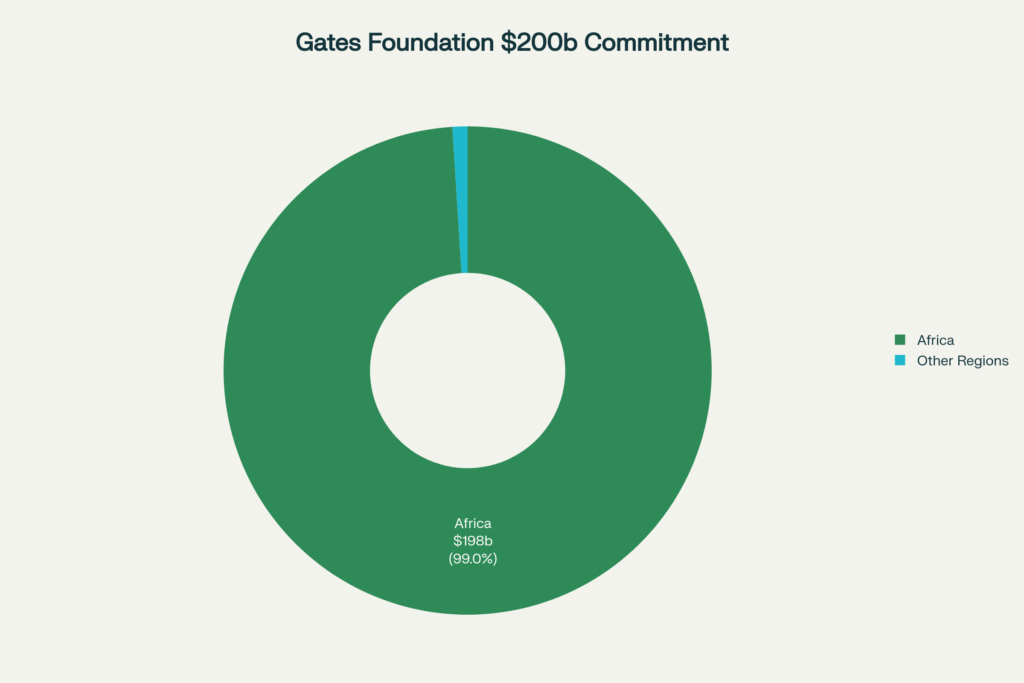
Geographic Distribution of Gates Foundation’s $200 Billion Future Commitment (2025-2045)
5. AI Foresight: Labor Economics and Ethical Parameters
5.1 Macro-Forecast
Gates posits that by 2035, generalist AI agents will eclipse human proficiency on 80% of professional task domains. The residual comparative advantage resides in code synthesis, grid systems engineering, and molecular biology—fields where iterative hypothesis generation and ambiguity tolerance remain distinctively human.
5.2 Adaptive Strategies
He recommends (i) continuous-learning budgets in corporate P&Ls, (ii) severance-to-scholarship transition vouchers for displaced workers, and (iii) national skills observatories to forecast micro-regional demand shocks.

6. Memoir “Source Code”: Epistemic Transparency
Gates’s February 2025 memoir delivers primary-source material on his neurodivergent tendencies, early computing immersion, and parental socialization of civic duty. For researchers, the text enriches the explanatory variables behind Microsoft’s formative culture—namely, an environment optimized for hyper-focus and cognitive abstraction.
7. Personal Life Dynamics
Public confirmation of Bill Gates partnership with Paula Hurd reflects a post-divorce relational stabilization. While seemingly peripheral, such life-course variables can influence philanthropic risk appetite; historical studies show a correlation between personal support networks and willingness to pursue high-beta social investments.


8. Vaccine Advocacy Amid Funding Headwinds
8.1 Quantitative Risk
U.S. congressional cuts to PEPFAR and multilateral soft-pledges risk ≈500 000 excess pediatric deaths by 2030. Gates’s counter-move—a $1.6 B Gavi pledge plus a $450 M Rotary match for polio—serves as contingency capitalization against that epidemiological shock.
8.2 Monitoring Framework
New real-time dashboards integrate satellite-derived population baselines with DHIS2 feeds, enabling near-month latency on vaccination-coverage gaps.
9. Domestic Economic Mobility: NextLadder Ventures
Launched with a $1 B war chest, NextLadder supplies mezzanine philanthropic capital to tech startups targeting income volatility. Program evaluators employ propensity-score matching to attribute causal wage gains to platform usage over a five-year horizon.
10. Investment Philosophy: Portfolio as Mission Enabler
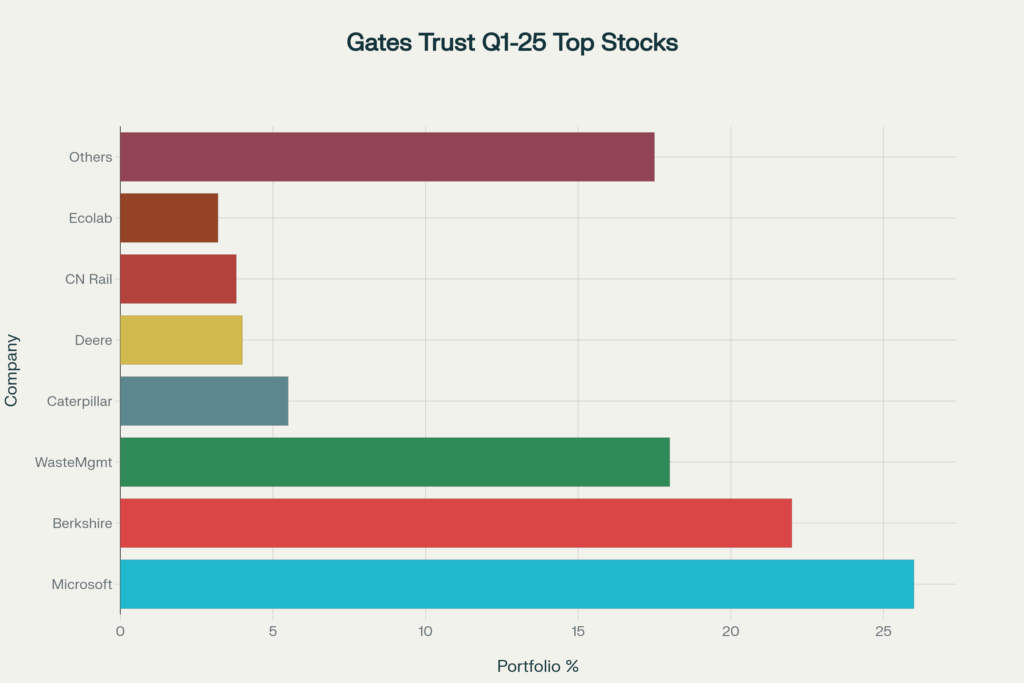
Cascade Investment LLC remains heavily weighted toward Berkshire Hathaway and Microsoft, generating dividend streams that bankroll near-term grant obligations. Simultaneously, new positions in heavy-duty electrification (Paccar) and sustainable logistics (FedEx) serve both return objectives and Gates’s decarbonization thesis.
READ ALSO: DeepSeek and the Era of Smart AI in 2025